

Operations
Part of Community management operations: workflows and review
A quality checklist for communities that covers access, answers, appeals and capacity
Check community quality across member access, answers, moderation, records, privacy, security, accessibility, staffing and continuous improvement.
Quality means the service helps eligible members complete the intended activity safely and consistently. It is not the absence of complaints or a high post count. Apply this checklist to a sample of real journeys, then assign each finding an owner and review date.
What to take away
- Quality means eligible members complete the intended activity safely and consistently, not the absence of complaints.
- Sample real journeys and outcomes rather than response times or post counts.
- Include supplier work in the same quality boundary as internal work.
- Retest corrected journeys and report gaps with evidence and consequence.
- A checklist adds value only when it changes service ownership or behaviour.
Access and understanding
- Can an eligible person understand who the community serves?
- Are joining, refusal, suspension and departure routes usable?
- Is visibility clear before a member contributes?
- Do navigation and content work with relevant devices and assistive technology?
- Can somebody obtain help when login fails?
Test with intended members, including people likely to face barriers. Internal staff familiar with the interface cannot represent a new participant.
Access and understanding checks
- Eligible person understands who community serves
- Joining, refusal, suspension, departure routes usable
- Visibility clear before member contributes
- Navigation and content work with devices
- Help available when login fails
Answer and activity quality
- Does each core activity connect to the stated member outcome?
- Are unanswered needs visible to an operator?
- Can specialist questions reach a qualified owner?
- Are corrections added where inaccurate material remains discoverable?
- Does the member know the next step when the community cannot help?
Sample outcomes, not merely response times. A rapid but irrelevant answer can make a headline measure look strong while increasing member effort.
Answer and activity quality
- Core activity connects to stated member outcome
- Unanswered needs visible to an operator
- Specialist questions reach a qualified owner
- Corrections added where inaccurate material remains
- Member knows next step when community cannot help
Moderation and appeals
- Are current rules easy to find and understand?
- Do similar cases receive consistent reasoning while allowing context?
- Are urgent issues separated from ordinary policy concerns?
- Can a member question an error through a usable route?
- Does review reach someone with authority to reconsider?
Preserve evidence proportionately and restrict access. Do not retain harmful material indefinitely merely because a quality audit might occur later.
Moderation and appeals checks
- Current rules easy to find and understand
- Similar cases receive consistent reasoning with context
- Urgent issues separated from ordinary policy concerns
- Member can question an error through usable route
- Review reaches someone with authority to reconsider
Information governance
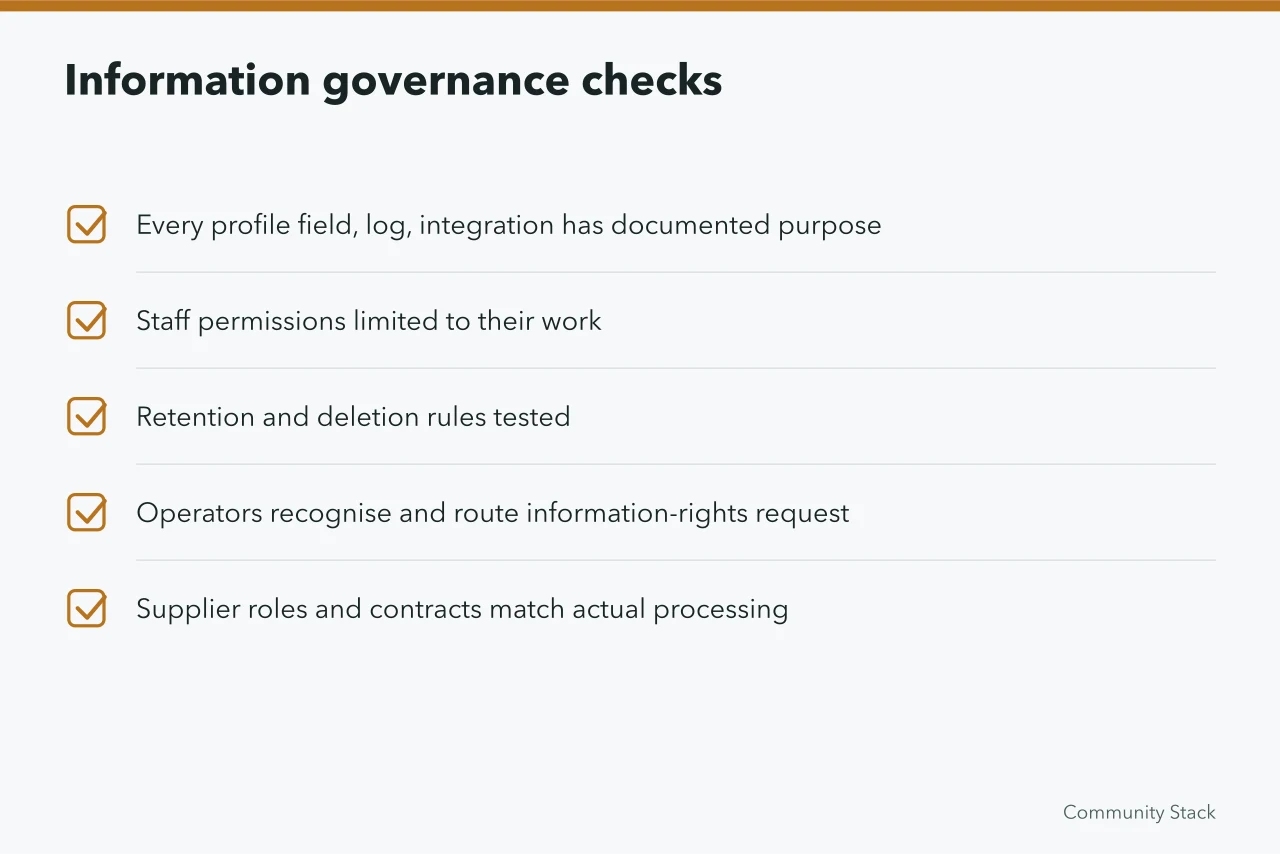
- Does every profile field, log and integration have a documented purpose?
- Are staff permissions limited to their work?
- Are retention and deletion rules tested?
- Can operators recognise and route an information-rights request?
- Do supplier roles and contracts match actual processing?
The Information Commissioner's Office's accountability framework provides a structured way to assess data protection practices. It is not a certificate or a substitute for qualified review.
Security and continuity
- Are administrative accounts protected and reviewed?
- Can the team detect significant configuration or access changes?
- Have backup and restore routes been tested where relevant?
- Are supplier and internal incident contacts current?
- Can member communication continue during a platform outage?
The National Cyber Security Centre's cloud security principles can inform a hosted-service assessment. Select controls according to the data and risk rather than collecting evidence nobody evaluates.
People and capacity
- Are daily tasks and decision rights assigned?
- Does absence cover match the member promise?
- Are training and escalation records current?
- Is specialist support available for the actual subject matter?
- Does forecast workload include reports, appeals and irregular cases?
Watch for hidden labour absorbed by product, support or volunteer colleagues. A service is not sustainable if it works only through unrecorded favours.
Improvement and accountability
- Are metrics defined and linked to decisions?
- Does sampling include quiet, unsuccessful and closed journeys?
- Are changes versioned with reasons and effective dates?
- Can staff explain which source supports a current rule?
- Does the accountable owner decide whether to continue, narrow or stop?
Calibrate the review
Give two reviewers the same small set of cases and compare their conclusions. Differences may reveal an unclear rule, missing context or inadequate training. Resolve the reason before expanding the sample. Agreement alone is not proof of a fair decision if both reviewers used the wrong standard.
Include supplier work in the same quality boundary. A hosted platform incident, outsourced moderator decision or expert response still affects the member. Record which party supplies evidence and who inside the organisation decides whether performance is acceptable.
Track corrections to closure. A promised fix should be retested on the original journey and, where relevant, communicated to affected members. Marking an action complete because a ticket was created confuses administration with improvement.
Report gaps with evidence and consequence, not a single quality score. Recheck corrected journeys. The checklist adds value when it changes service ownership or behaviour, not when every box is marked through optimistic interpretation.
Before you act
- Test access with intended members, including people facing barriers.
- Sample outcomes, not merely response times.
- Preserve evidence proportionately and restrict access.
- Test retention and deletion rules.
- Assign daily tasks and decision rights.
- Calibrate reviewers on the same small set of cases.
Common questions
Why is a rapid answer not always a good answer?
The article says a rapid but irrelevant answer can make a headline measure look strong while increasing member effort. It advises sampling outcomes rather than merely response times, because quality means the service helps eligible members complete the intended activity safely and consistently.
How should a community handle harmful material during a quality audit?
Preserve evidence proportionately and restrict access. The article warns against retaining harmful material indefinitely merely because a quality audit might occur later. Retention and deletion rules should be tested, and every profile field, log and integration should have a documented purpose.
What does agreement between two reviewers prove?
Not much on its own. The article says agreement alone is not proof of a fair decision if both reviewers used the wrong standard. Differences may reveal an unclear rule, missing context or inadequate training, so resolve the reason before expanding the sample.