

Costs and pricing
Part of How to build a community budget that finance will trust
Community return on investment only counts once the counterfactual is written down
Calculate community ROI from an evidenced counterfactual, attributable benefits, complete costs, uncertainty ranges and non-financial member outcomes.
Return on investment compares attributable financial benefit with the complete cost of the community over the same period. It is not revenue from every member who viewed a post. The most important step is defining what would probably have happened without the intervention.
What to take away
- Define the counterfactual before calculating return on investment, as it is the most important step.
- Map each benefit through observable steps and avoid valuing every page view as a deflected ticket.
- Use the formula eligible volume x measured change x attributable share x unit value for each benefit.
- Include complete costs such as discovery, implementation, licences, hosting, integrations, staff and exit.
- Report contribution and uncertainty if the evidence cannot isolate impact rather than an exact ROI.
Write the decision and counterfactual
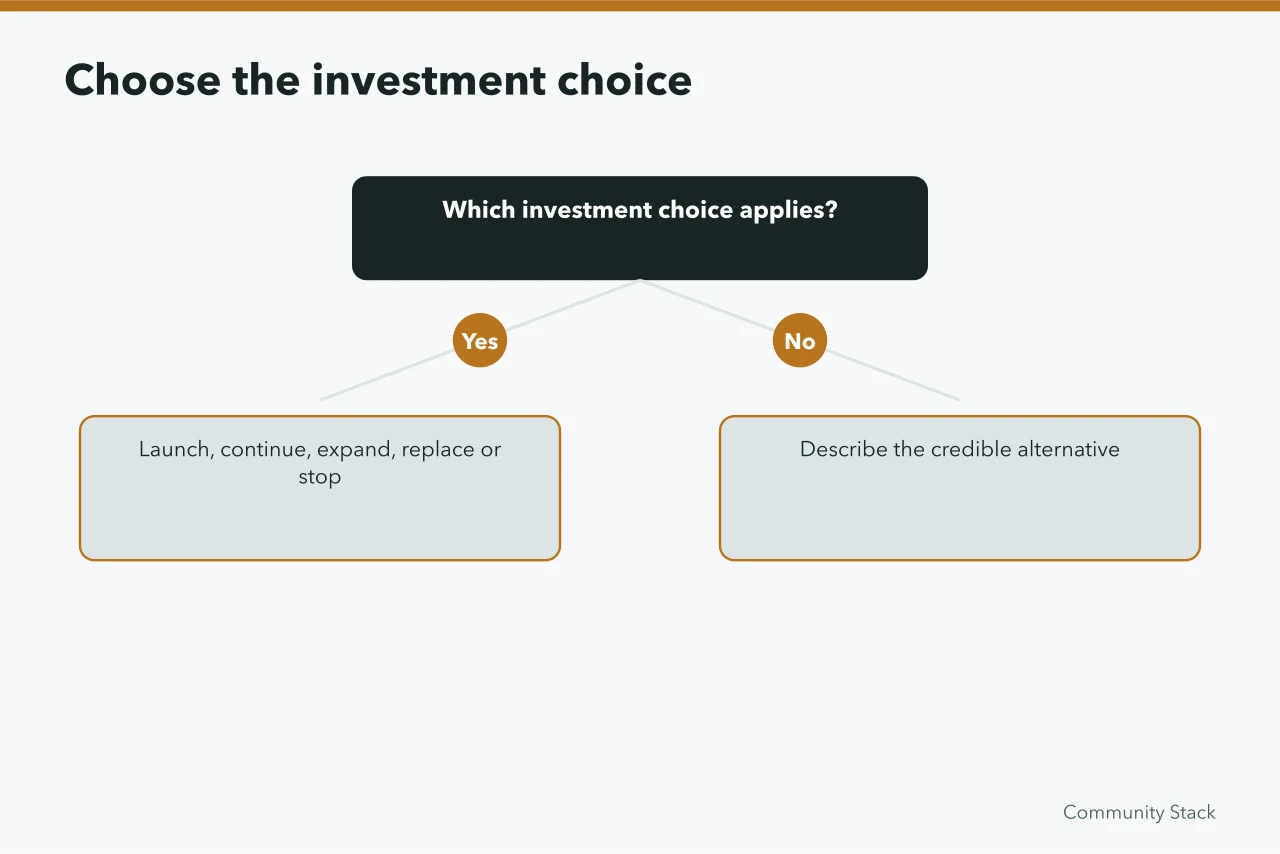
Choose the investment choice: launch, continue, expand, replace or stop. Describe the credible alternative. It may be direct support, events, documentation, another channel or no service change.
Use a baseline from the same population and definition. A before-and-after comparison can still be distorted by seasonality, product changes, campaigns or customer mix. Record these competing explanations.
The UK government's Magenta Book provides guidance on evaluation design for public policy. A commercial community is different, but the core discipline of planning how to assess an intervention and its counterfactual helps prevent attribution by assertion.
Identify the benefit route
Map each proposed benefit through observable steps. For support efficiency:
Support efficiency benefit route
- Eligible question enters the community
- Member receives an appropriate answer
- Direct support contact avoided or shortened
- Saved work has a defensible unit cost
Do not value every page view as a deflected ticket. Sample resolved journeys and check whether the member still contacted support.
For retention or sales, compare suitable groups and control for material differences where possible. A customer who joins may already be more committed than one who does not. Membership therefore correlates with the outcome without necessarily causing it.
Calculate attributable value
For each benefit, use:
Attributable value formula
- Eligible volumequestions or members in scope
- Measured changeobserved shift in outcome
- Attributable shareshare credibly caused by community
- Unit valuedefensible cost per unit
eligible volume x measured change x attributable share x unit value
Publish low, central and high assumptions. The attributable share should reflect evaluation evidence, not the number required to make the business case positive.
Keep non-cash benefits separate unless finance agrees a conversion. Faster learning, stronger peer relationships and improved access may matter without having a reliable pound value.
Include complete cost
Count discovery, implementation, licences, hosting, integrations, staff, external moderation, expert answers, assurance, training, incidents, change and exit. Use loaded employment cost and actual supplier terms. Avoid comparing gross benefit with only the platform fee.
Complete cost categories
- Discovery and implementation
- Licences, hosting and integrations
- Staff, external moderation and expert answers
- Assurance, training and incidents
- Change and exit
Discounting and appraisal treatment should follow the organisation's finance policy. HM Treasury's Green Book concerns public-sector appraisal, so a private organisation should not copy its parameters blindly. It is useful for understanding structured options, costs, benefits and uncertainty.
Design the measurement before launch
Choose comparison groups, periods and data sources while the intervention can still be changed. Define eligibility, resolution, retention and cost units before seeing results. Pre-agreed definitions reduce the temptation to select a favourable denominator later.
Where a controlled comparison is impractical, combine evidence. Review matched cohorts cautiously, sample member journeys, ask about alternative routes and examine operational records. Explain remaining selection bias. A precise spreadsheet cannot remove a weak counterfactual.
Check for displacement. A community answer may reduce one support channel while increasing expert time elsewhere. A new membership benefit may move participation from events rather than create additional value. Follow the whole service route.
Assign owners to data quality and benefit realisation. The community operator should not be solely responsible for validating a financial claim on which their budget depends.
Report the result honestly
The simple formula is:
(attributable financial benefit - complete cost) / complete cost
Show the period, population, definitions and sensitivity range beside the figure. Also present safety, quality and inclusion indicators. A positive financial result does not justify harmful moderation or inaccessible service.
Assign an independent reviewer to challenge attribution and omitted cost. If the evidence cannot isolate impact, report contribution and uncertainty rather than an exact ROI. The calculation should improve a decision, not manufacture confidence after the investment has already been chosen.
Before you act
- Choose the investment choice and describe the credible alternative.
- Use a baseline from the same population and definition.
- Sample resolved journeys to check if members still contacted support.
- Publish low, central and high assumptions for each benefit.
- Count complete cost including discovery, implementation, licences, hosting and staff.
- Assign an independent reviewer to challenge attribution and omitted cost.
Common questions
Why is a before-and-after comparison not enough for a community ROI?
A before-and-after comparison can be distorted by seasonality, product changes, campaigns or customer mix. These competing explanations must be recorded. The text advises using a baseline from the same population and definition to avoid such distortions.
How should non-cash benefits be treated in a community ROI calculation?
Non-cash benefits should be kept separate unless finance agrees a conversion. Faster learning, stronger peer relationships and improved access may matter without having a reliable pound value. They should not be included in the financial calculation without agreement.
What should be done if a controlled comparison is impractical?
Combine evidence by reviewing matched cohorts cautiously, sampling member journeys, asking about alternative routes and examining operational records. Explain remaining selection bias. A precise spreadsheet cannot remove a weak counterfactual, so report contribution and uncertainty rather than an exact ROI.