

Audience research
Part of Research prospective members properly before deciding what to build
Competitor research for community services without pretending to have tested them
Research community competitors in England through a fixed service boundary, first-party claims, public records and evidence gaps that need direct checks.
Competitor research should show which alternatives address the same member and buyer problem. It should not turn marketing pages into a league table. Use this checklist for a dated study of software, managed services or combined community offers available to an English buyer.
What to take away
- Competitor research should show which alternatives address the same member and buyer problem, not rank marketing pages.
- Separate software suppliers from agencies and consultants, and keep unlike categories apart until the buyer's decision is clear.
- Every named provider in a published comparison needs its own first-party source, not a logo on a directory.
- Desk research must stay labelled as desk research, and a free trial needs disclosure of who used it and when.
- Turn public evidence gaps into questions for demonstrations, references and due diligence rather than assumptions.
Fix the relevant market
- State the member group, use case, geography and delivery boundary.
- Decide whether existing internal teams, social channels and event programmes count as alternatives.
- Separate software suppliers from agencies and independent consultants.
- Write inclusion and exclusion rules before naming familiar businesses.
A forum platform and a moderation service may both appear in a broad search, but they do not supply the same work. Keep unlike categories apart until the buyer's decision is clear.
Fix the relevant market
Do internal teams, social channels, events count?
Include as alternatives in the market
Exclude and note the reason
Establish legal and trading identity
- Record the trading name shown on the service page.
- Find the contracting entity and company number where applicable.
- Note group ownership and disclosed offices.
- Date the record because status and ownership can change.
Companies House explains what can be found when searching its register. Public filings support identity and corporate-history checks. They do not prove service quality, current staffing or community expertise.
Establish legal and trading identity
- Record trading name on service page
- Find contracting entity and company number
- Note group ownership and disclosed offices
- Date the record for status changes
Capture claims at their real scope
- Save the exact page that describes each claimed service.
- Distinguish platform functions, implementation, moderation, strategy and analytics.
- Mark claims made by the supplier, a customer quotation or an independent body.
- Preserve territory and date beside certifications, partnerships or awards.
- Leave a field blank when public evidence is missing.
Every named provider in a published comparison needs its own first-party source. A logo on a third-party directory is not enough. Ask the supplier to confirm material claims in a proposal and contract.
Capture claims at real scope
- Save exact page describing each claimed service
- Distinguish platform, implementation, moderation, strategy, analytics
- Mark supplier, customer quotation or independent body
- Preserve territory and date beside certifications
- Leave a field blank when evidence is missing
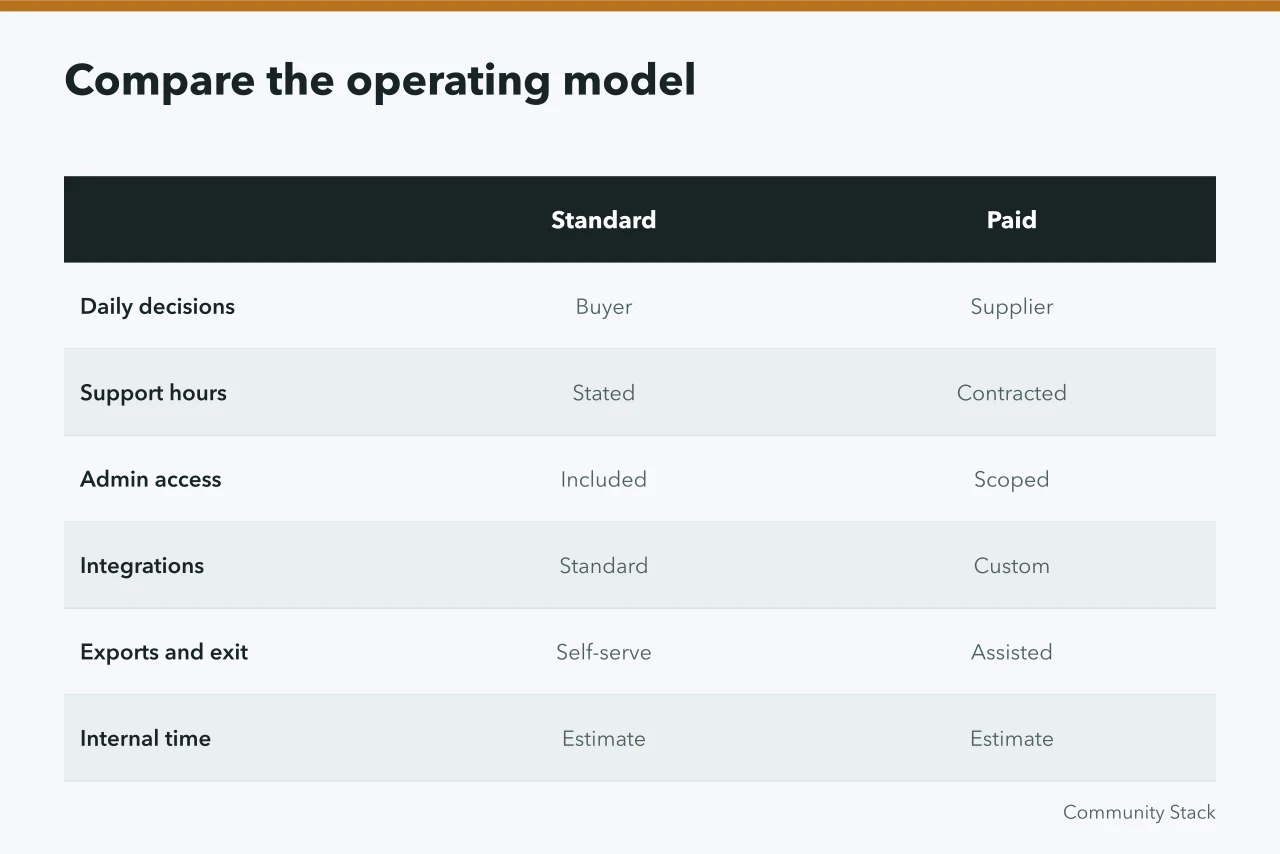
Compare the operating model
- Identify who owns daily decisions and member relationships.
- Check stated support hours and escalation routes.
- Map administrator access, integrations, exports and exit work.
- Separate standard configuration from paid implementation.
- Estimate internal time as well as quoted fees.
Do not infer that "managed" includes round-the-clock moderation or that "enterprise" means a named control is present. Those words need a precise definition for the procurement in question.
Examine names and positioning
The UK Intellectual Property Office provides a trade mark search service. It can help identify registered marks that may affect a proposed brand name. It does not establish wider passing-off risk or guarantee that a name is commercially distinct. Obtain qualified advice where the decision requires it.
Compare the language competitors use for audiences, outcomes and delivery, then return to customer research. Repeating a popular category term may improve recognition but make the offer less precise.
Review visible evidence without pretending to test
Capture public demonstrations, documentation and case studies only for the claims they actually make. A customer story selected by a supplier can reveal the described use case, but it cannot establish a typical outcome. Do not create a performance score from page design, social activity or the number of published testimonials.
If a review involves a free trial, disclose who used it, the date, configuration and tasks attempted. Desk research must stay labelled as desk research. Neither method justifies a reliability claim without suitable evidence over time.
Record what cannot be learned publicly
- People actually assigned to the account.
- Moderator judgement in difficult cases.
- Product performance at the buyer's expected scale.
- Contract flexibility and data returned at exit.
- Current customer satisfaction outside selected testimonials.
Turn these gaps into questions for demonstrations, references and due diligence. Do not fill them with assumptions or assign zero scores simply because the public site is silent.
Produce a decision record
Use one row per provider and one evidence link per claim. Keep observations separate from interpretation. The final note should identify the closest alternatives, meaningful differences, unresolved questions and the research date.
Refresh the study before it supports a public comparison or purchase. Competitor research is credible when another reviewer can follow every conclusion back to a source and see where the evidence stops.
Before you act
- State the member group, use case, geography and delivery boundary.
- Write inclusion and exclusion rules before naming familiar businesses.
- Save the exact page describing each claimed service.
- Leave a field blank when public evidence is missing.
- Separate standard configuration from paid implementation.
- Refresh the study before it supports a public comparison.
Common questions
What should competitor research show rather than turn marketing pages into?
It should show which alternatives address the same member and buyer problem. It should not turn marketing pages into a league table. The article says to use a checklist for a dated study of software, managed services or combined community offers available to an English buyer.
Why does the article say to keep unlike categories apart?
A forum platform and a moderation service may both appear in a broad search, but they do not supply the same work. The article says to keep unlike categories apart until the buyer's decision is clear, and to separate software suppliers from agencies and independent consultants.
What should happen when public evidence is missing?
Leave a field blank when public evidence is missing. Do not fill gaps with assumptions or assign zero scores simply because the public site is silent. Turn those gaps into questions for demonstrations, references and due diligence, and keep observations separate from interpretation.