

Reviews
Reviewing community products and providers with an evidence hierarchy and repeatable tests
Review community products and providers through declared scope, first-party evidence, repeatable tests, integrity controls, limits and buyer decisions.
A useful review shows an English buyer what was examined, how evidence was obtained and whether the same conclusion applies to its member service. It distinguishes a provider's public description from a buyer's test and a contractual promise. It also preserves failures, conflicts and missing evidence.
This guide sets a method for comparing community software and agencies. It includes named examples from official pages checked on 5 September 2026, but no hands-on testing, supplier payment, user-review synthesis or ranking was conducted. Appearance does not imply endorsement.
What to take away
- Review community products against a written test plan, not a brochure.
- Give every candidate the same tasks, data and devices.
- Keep a dated log of tests, corrections and unresolved risks.
- Publish limitations beside each conclusion.
Define the purchasing question
Write the member outcome, audience, geography, activity, service hours, information risk and internal capability. Then state which layer is being reviewed:
Which layer are you reviewing?
Which layer is being reviewed?
Software -> test product journeys
Services -> test judgement and staffing
Do not compare a software platform with an agency as though both provide the same work. One may supply the application while the other supplies judgement and staffing. Where a buyer needs both, evaluate each layer and the handoff.
Set inclusion and exclusion criteria before naming providers. Describe search channels, review date, territory and category boundary. A list found through familiar names is not a market survey.
Publish the disclosure
State whether the work used desk research, supplier demonstrations, trial access, a paid purchase, client references or member tests. Name who performed each task, the date, plan, configuration and limitations.
Disclose supplier payment, affiliate commission, gifts, free access and editorial contact. A free trial does not make a review dishonest, but hiding it prevents readers from judging independence.
If no one used the product, do not write in the first person as though testing occurred. If one reviewer completed a short trial, do not extend the observation to long-term reliability, scale or every plan.
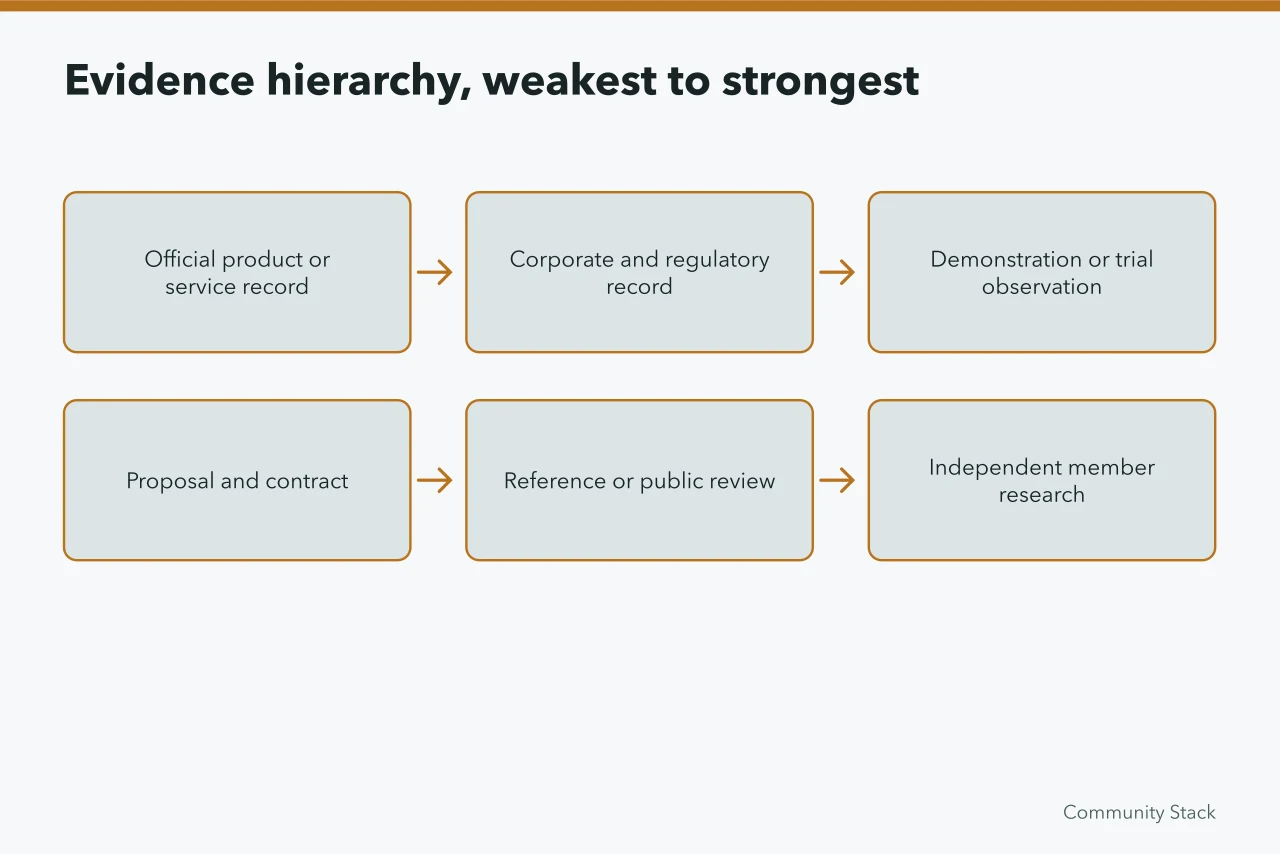
Construct an evidence hierarchy
Official product or service record
The provider's own page establishes how it described the offer on the review date. Link the exact product or service page for every named entry. It does not prove that a feature works in the buyer's configuration or that a claim is typical.
Corporate and regulatory record
Companies House explains how to search its register. The record can support legal identity, filing and officer checks, within its stated limits. It does not certify competence, staffing or solvency.
Demonstration or trial observation
A reviewer can document what occurred under specified conditions. Preserve task, inputs, expected result, observed steps, errors and workaround. A successful trial is not a future service commitment.
Proposal and contract
A written response or negotiated term can allocate scope, service level, responsibility and remedy. Keep it separate from public marketing language and confirm the contracting entity.
Reference or public review
A provider-selected reference can describe a client's experience. A public review may have unknown identity or incentive. Both can inform questions, but neither automatically represents other buyers.
Independent member research
Testing with intended members can reveal access, understanding and effort. A small sample supports qualitative findings under its conditions, not England-wide prevalence.
Create repeatable product tests
Translate requirements into member and operator journeys. Include:
Six repeatable product tests
- Eligible person joins with intended visibility
- Member finds an answer and judges context
- Contribution is reported to right operator
- Moderation error is appealed and corrected
- Administrator replaced without excessive access
- Data exported and opened outside product
Use the same data, devices and tasks for every candidate. Record customisation and plan because results may depend on them. Have the intended operator repeat administrative work after the supplier demonstrates it.
An illustrative log row shows how a failed mandatory task removes a candidate:
| Task | Candidate and plan | Expected result | Observed result | Outcome |
|---|---|---|---|---|
| Replace an administrator | Candidate A, team plan | Owner promotes a member to admin within five minutes | Invite not received, second attempt succeeded after a support reset | Fail |
Because administrator replacement was mandatory, Candidate A leaves the shortlist even if the other five tasks passed.
Accessibility review should include registration, navigation, posting, notification, reporting and departure. A product's published accessibility material is useful, but buyer configuration and embedded components can change the experience.
Security and data tests require specialist interpretation. Map profiles, content, messages, moderation notes, analytics and integrations. Review authentication, privilege, sub-processors, recovery, incident contacts and rights assistance.
Evaluate managed services through cases
Give agencies the same workload range, channels, languages, hours, rules, escalation map and reporting needs. Ask each to identify included work, assumptions and client dependencies.
Use cases that expose judgement:
Judgement cases for agencies
- Routine question needs a product expert
- Member posts plausible but unsafe advice
- Commercial recommendation lacks disclosure
- Serious report arrives outside ordinary hours
- Participant requests personal information access
- Platform outage blocks the agreed queue
Evaluate reasoning, authority, evidence and handoff. A polished sample response is less useful than understanding when the team stops and contacts the buyer's specialist.
Meet staff likely to deliver the account. Ask about training, supervision, absence, substitution and quality review. Do not infer local capacity from a global headcount.
Use named provider examples carefully
A current provider list should tell the reader why each entry was eligible and what its first-party record supports. Each entry below was included for a stated reason and checked on 5 September 2026 against one page on the provider's own site.
For example, ICUC describes community management and moderation among its services and lists a London location. It was included because community management and moderation are named services; the page checked was the ICUC services page.
Standing on Giants presents outsourced community management, strategy, training and platform work and identifies a London base. It was included because outsourced community management is its stated offer; the page checked was the Standing on Giants services page.
Social AF describes community and supporter-experience services for charities. It was included because charity community work is its stated focus; the page checked was the Social AF services page.
StrawberrySocial presents community engagement, moderation and customer-service support. It was included because moderation and engagement are named services; the page checked was the StrawberrySocial services page.
The Social Element includes community management within a broader social agency offer and states that it has a UK headquarters. It was included because community management sits inside a wider social offer; the page checked was The Social Element services page.
These are official descriptions, not reviewer findings about performance. Verify assigned people, actual delivery location, coverage, price, contract and references. An alphabetical inclusion list should not be labelled "best" without an evidence-based ranking method.
Compare products without counting features
Public records show different product directions. Circle describes community, courses and events. Discourse offers open-source discussion software and hosting. Higher Logic Vanilla is presented as customer-community software, while Mighty Networks combines communities, memberships and courses.
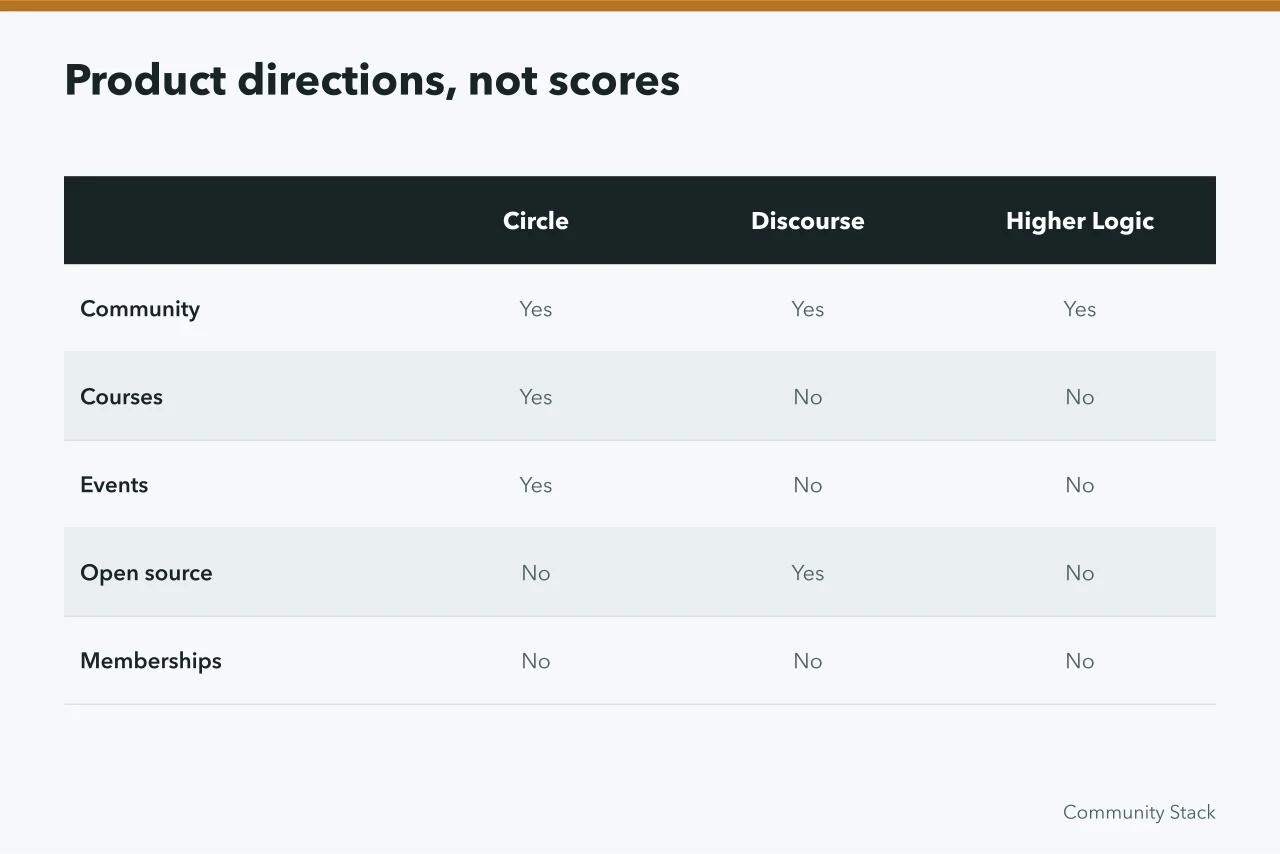
Do not convert those descriptions into a score. Test whether the selected plan supports the exact member and operator journeys. A feature mentioned on a global page may not be available under the buyer's edition or terms.
Compare complete cost over the same period and usage cases. Include licences, implementation, migration, integrations, staffing, assurance, support, change and exit. Public prices are volatile and may omit taxes or negotiated scope.
Keep mandatory failures outside an average. Strong design options should not cancel an unsafe permissions gap. Report category findings and unresolved risks separately.
Read customer reviews with provenance
Record the original page, date, claimed relationship, service, period and any disclosed incentive. Preserve context around extracts. Check whether the review concerns community operation, social content, software or another service.
Agency-site testimonials are selected by the agency. Procurement references are supplied by the candidate. Public review platforms have their own identity and moderation systems. Treat each according to its method rather than assigning automatic truth or falsity.
Do not average ratings across different platforms, periods or definitions. Use recurring themes to form due-diligence questions and test them with current evidence.
UK rules
The Competition and Markets Authority's fake reviews guidance, reference CMA208, addresses banned practices around fake and concealed incentivised reviews and misleading review information. The publication date is shown on the guidance page; check it before citing the document. Publishers and businesses should establish their responsibilities from current guidance and qualified advice.
Protect editorial integrity
Give named providers a route to correct factual identity, product or service errors before publication. Record material responses. Do not give them control over editorial judgement or remove a supported limitation in exchange for access.
Keep testing notes and evidence for the period necessary under the publication and data policies. Avoid retaining personal review information that is not needed.
Disclose reviewer competence. A community operator can assess workflow, while security, privacy, accessibility and legal claims may need qualified specialists. One person should not claim authority across every category.
Separate sponsored placements from editorial inclusion. A visible label does not make an unsupported review claim accurate, and a high affiliate payment should never determine the winner.
Write conclusions at the evidence level
Use language such as:
Claim language by evidence level
Evidence level
- First-party page
- The provider's page states
- Documented testing
- The reviewer observed
- Accepted obligation
- The contract requires
- Attributed client
- The reference reported
- No evidence
- Evidence was unavailable
Allowed wording
- First-party page
- Documented testing
- Accepted obligation
- Attributed client
- No evidence
Avoid "best", "leading", "reliable" and "easy" unless the method defines and supports the claim for the stated buyer. Tie each conclusion to the log row and the evidence level that supports it, such as a dated trial result or a signed contract clause.
Publish limitations beside the conclusion: untested plans, unavailable contracts, small samples, missing performance data, location boundaries and review date. A narrow answer can be more useful than an expansive rating built on weak evidence.
Recheck and maintain the review
Products, teams, pricing, ownership and regulation change. Assign dates to every volatile fact. Before publication or procurement, reopen official records and confirm links, plan names, availability and legal entity.
Maintain a change log. If a provider corrects a factual claim, date the correction. If a product removes a feature, update the relevant conclusion rather than silently rewriting the whole comparison.
Retire a ranking or list when its cohort and evidence no longer meet the published method. Historical search visibility is not a reason to keep an inaccurate recommendation live.
The strongest review does not pretend to make the buyer's decision. It supplies a reproducible test, evidence provenance and clear limits so the organisation can judge fit against its own members, capacity and accepted risk.
Before you act
- Dated test log listing each task, plan, configuration and pass or fail.
- Disclosure note naming desk research, demonstrations, trials, paid access and supplier contact.
- Contract clause covering scope, service level, remedy and exit.
- Inclusion and exclusion criteria with the review date.
- Evidence file holding first-party pages, screenshots and correspondence.
- Limitations note listing untested plans and missing data.
Common questions
What does an official product page actually establish?
Treat it as the baseline record. Save the URL, the date and the exact wording, then log any difference between that description and what a trial or contract shows. A page you cannot date is weak evidence.
How should a buyer test a community product?
Translate requirements into member and operator journeys, then run the same data, devices and tasks for every candidate. Cover joining, finding an answer, reporting, appealing a moderation error, replacing an administrator and exporting data. Record customisation and plan because results may depend on them.
Why should ratings from different platforms not be averaged?
Platforms have their own identity and moderation systems, and reviews may cover different services, periods or definitions. Averaging them mixes incomparable evidence. Instead, use recurring themes to form due-diligence questions and test those questions with current evidence from the provider.
In this guide
- Community management review methodology in England: five provider checks, from Companies House to Cyber EssentialsReview community software and providers in England: Companies House identity, ICO fee, Cyber Essentials, WCAG 2.2 AA and the DMCC Act review rules.
- Five community management providers with English operations, read from their own pagesExamine five community-management providers with English operations using official service pages, then shortlist by scope, evidence and buyer need.
- Reading community platform prices in dollars as a UK buyerHow a UK buyer reads dollar price pages for four community platforms, turns them into dated pound quotes and finds the costs the pages leave out.
- Reading community agency reviews with an eye for provenance and incentiveAssess community agency reviews in England by checking identity, scope, evidence provenance, comparable clients, incentives, failures and freshness.
- Community selection checklist: normalise quotes, then apply gatesCompare two community supplier quotes like for like: scope the service, normalise fees, add internal cost, set mandatory gates and record conditions.